

Master Portuguese Through Culture – Discover why learning through real Portuguese culture, not just grammar rules, transforms the way you speak
Why Culture Is the Missing Piece in Your Portuguese Journey
Master Portuguese Through Culture, Many learners start studying Portuguese with apps, grammar books, and vocabulary lists — and yet, months later, they still can’t hold a conversation. Why? Because language is not just words. It’s culture.
If you want to sound natural, confident, and connected, you need to live the language, not just memorize it. That’s where cultural immersion — through music, films, stories, and traditions — changes everything.
At PortugueseNative.com, we believe that true fluency happens when you understand not just what to say, but how and why native speakers say it.
What “Learning Portuguese Through Culture” Really Means
To learn Portuguese through culture and immersion is to experience the language as part of daily life. Instead of isolating words on a page, you encounter them in music, film, conversation, and traditions.
Immersion isn’t only about travel (though that helps!). It’s about connecting with culture — even from your home. You can:
- Watch Brazilian movies with Portuguese subtitles
- Listen to Portuguese podcasts or Fado songs
- Read blogs like PortugueseNative.com
- Follow creators on YouTube or Instagram who speak natively
Every time you experience the language in context, your brain builds deeper associations between sound, meaning, and emotion.
To experience this, start exploring authentic resources like:
- Vocal Media articles that dive into the soul of the Portuguese language.
- Portuguese literature, short stories, and podcasts that reveal how people think and express emotion.
Learn Portuguese Through Music
Music is one of the most powerful cultural tools for language learning. Brazilian and Portuguese songs expose you to pronunciation, rhythm, and colloquial expressions that textbooks never teach.
Example artists to explore:
- Caetano Veloso – poetic lyrics that teach advanced vocabulary.
- Anitta – catchy pop that uses everyday language.
- Mariza – introduces learners to traditional Fado.
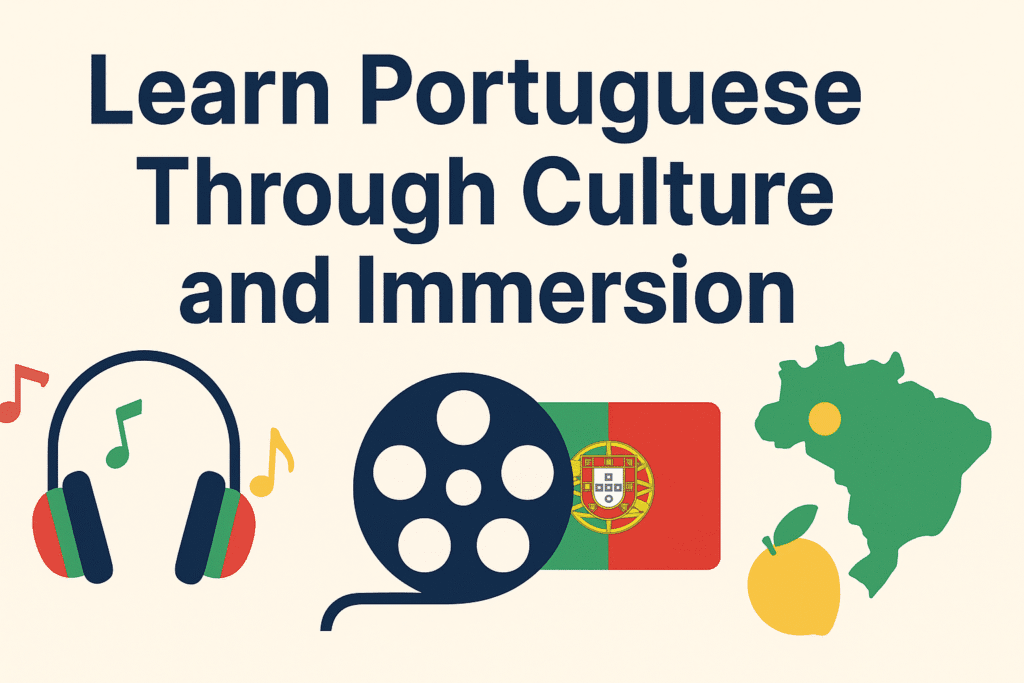
🎧 Image suggestion: A vibrant illustration of headphones, Brazilian flag colors, and musical notes.
Alt text: “Learn Portuguese through culture and immersion using Brazilian music.”
When you sing along, your pronunciation and memory improve naturally. You internalize grammar patterns, build vocabulary, and strengthen your listening comprehension without effort.
Learn Portuguese Through Movies and Series
Films are another window into cultural immersion. Watching Brazilian or Portuguese productions allows you to observe accents, gestures, and cultural nuances that define the language.
Recommended movies and series:
- Cidade de Deus (City of God) — a raw, emotional story set in Rio de Janeiro.
- O Auto da Compadecida — brilliant humor and regional expressions.
- Glória (Netflix) — Portuguese history meets Cold War drama.
While watching, keep subtitles on in Portuguese (not English). This keeps your brain immersed in the language. Repetition is key: rewatch scenes, mimic dialogue, and note idiomatic phrases.
You can explore more of these unique words and cultural nuances in our feature on Vocal Media: “10 Beautiful Portuguese Words You Can’t Translate into English.
Cultural Immersion Builds True Fluency)
Why does learning Portuguese through culture and immersion work better than traditional study? Because it replicates how your brain naturally learns languages — through pattern recognition and emotional connection.
When you learn through culture:
- You remember vocabulary because it’s tied to context and feeling.
- You understand meaning intuitively instead of translating.
- You speak with more confidence and authenticity.
Unlike rote memorization, immersion involves the heart as much as the mind. You stop studying and start living the language.
Real-Life Practice: The Key to Retention
Even if you can’t live in Portugal or Brazil, you can recreate immersion digitally.
Here are practical ways to learn Portuguese through culture and immersion daily:
Travel virtually.
Watch travel vlogs or documentaries about Portuguese-speaking destinations.
Change your phone and apps to Portuguese.
You’ll learn dozens of new words each day.
Join language exchange groups online.
Try Tandem or HelloTalk.
Follow blogs and creators like Portuguese Native for real examples.
Cook Portuguese or Brazilian recipes.
Reading and following recipes in Portuguese builds real-world vocabulary.
How You Can Start Today
- Choose one song or movie in Portuguese this week.
- Look up the lyrics or subtitles and note three expressions.
- Visit PortugueseNative.com to find free exercises that reinforce what you learned.
- Read our full article on Vocal Media for step-by-step guidance.
By combining culture, structure, and consistent practice, you’ll speak Portuguese faster — and enjoy the process.
Subtle Grammar and Pronunciation Gains
When you learn Portuguese through culture and immersion, grammar becomes natural. You start noticing how sentences are formed in real conversations or songs.
For example, after hearing “Eu vou te ligar mais tarde” (I’ll call you later) repeatedly in a song, you subconsciously understand object placement rules without memorizing them.
Similarly, pronunciation improves through exposure. By listening to authentic Portuguese daily, your ear adjusts to sounds like “lh” (melho), “ão” (pão), or “r” (carro).
Why Traditional Study Alone Isn’t Enough
Memorizing rules and vocabulary lists has value—but only when paired with culture. Traditional study builds awareness, but immersion builds instinct.
Many learners struggle with fluency not because they lack knowledge, but because they’ve never connected emotionally to the language.
Culture provides that missing piece — making every word meaningful.
Start Your Journey Today – Master Portuguese Naturally Through Culture
If you’re ready to learn Portuguese through culture and immersion, start small but consistent.
Watch a short film, learn the lyrics to a song, or read an article from Portuguese Native.
Each small interaction adds up to natural fluency — no stress, no translation, just connection.
Conclusion of Master Portuguese Naturally Through Culture
Learning Portuguese through culture isn’t a shortcut — it’s the natural path to fluency.
The more you connect with real Portuguese life — through art, music, humor, and emotion — the easier it becomes to express yourself with confidence and authenticity.
So next time you open your textbook, balance it with a little rhythm, cinema, or poetry.
Because the secret to fluency isn’t just study — it’s immersion.
👉 Explore lessons and resources at Portuguesenative.com and start living the language today.