
Origins of the names of Portugal regions. In Portugal, the names of provinces, districts and islands reveal geography, conquest, language contact and centuries of daily life. Below is a guided tour through the etymology of Portugal’s historical provinces, the names of its district capitals and the two autonomous archipelagos, explained in a clear and conversational way.
Historical provinces: meanings behind the six original names
Portugal’s first large-scale internal division, appearing around the 15th century, grouped the country into six provinces from north to south. Each name highlights a geographic feature, a frontier or a cultural contact.
- Entre-Douro-e-Minho — literally “between the Douro and the Minho.” The rivers give the region its name. Minho appears in ancient records as Minius or Mineus and may come from an Indo-European root meaning “to walk/go” (mei-) or from a root associated with mountains (men-). Douro likely goes back to pre-Roman times: Celts possibly called it Durio, from their word dur meaning “water,” later Latinized as Durius.
- Trás-os-Montes — “beyond the mountains.” The name points to the Alvão and Marão ranges that separate coastal northern Portugal from its inland highlands.
- Beira — from a word meaning “edge,” “margin” or “limit.” In the Middle Ages Beira marked an important frontier with Spanish kingdoms, lying between the Douro and the Tagus and functioning as the kingdom’s eastern limit.
- Estremadura — shares a root with Spanish Extremadura. Two main theories exist: one links the name to Latin extrema dorii (“beyond the Douro”), but this does not fit the geography well. The more convincing explanation treats Estremadura as “land of the extreme” or borderland, a term used during the Christian reconquest for frontier zones facing al-Andalus.
- Alentejo — literally “beyond the Tagus” (além do Tejo). The Tagus/Tejo was central to territorial identity; the name comes from the Latin Tagus, though the origin of that older name is uncertain.
- Algarve — from Arabic al-Gharb, “the west.” The full medieval form was al-Gharb al-Andalus, the western part of Muslim Iberia.
From six provinces to eleven: small shifts, familiar names
By the 19th and 20th centuries the provincial map was redrawn into 10, then 11 provinces. The new names mostly split existing regions into upper and lower zones or coastal and inland parts. Examples include:
- Douro Litoral — coastal Douro region (Litoral = coastline)
- Trás-os-Montes e Alto Douro — Trás-os-Montes together with the higher Douro valley
- Beira Alta / Beira Litoral / Beira Baixa — Beira divided into higher, coastal and lower parts
- Alto Alentejo / Baixo Alentejo — higher and lower Alentejo
- Ribatejo — the area along the Tagus bank. Riba comes from Latin ripa (bank), related to French rive.
Portuguese history and culture
Districts: towns that give their names to whole regions
Portugal’s modern political map centers on 18 districts (plus two autonomous regions). Each district usually takes the name of its capital city, so the origin of a district name is often the origin of a city name. Here’s a north-to-south look at the most interesting etymologies.
North and inland names of origins of the names of Portugal regions
- Viana do Castelo — originally the medieval town of Viana (likely pre-Roman in origin). In 1848 the suffix do Castelo (“of the castle”) was added to distinguish it from Viana do Alentejo and to reference the Castle of Santiago da Barra.
- Braga — from the Roman name Bracara Augusta, combining the Celtic tribe Bracari and an honorific for Emperor Augustus.
- Porto — from Latin Portus Cale. Portus simply means port. Cale probably refers to the Callaeci (a Celtic people) and gave rise not only to the city name but ultimately to Portugal itself.
- Vila Real — “royal town,” founded by King Dinis in 1289.
- Bragança — from Roman Brigantia, based on the Celtic briga meaning “hill” or “fortress.”
- Guarda — from the verb “to guard.” Its high, strategic position (over 1000 m) made it a guarding point against incursions from Spain.
- Viseu — attested as Vissaium in a 1st century AD document, but the deeper origin remains uncertain.
Central and western names in origins of the names of Portugal regions
- Aveiro — the name likely stems from a Celtic word aber meaning “river mouth” or estuary, a fitting label for this lagoon city (think of Welsh place names like Aberystwyth).
- Coimbra — Romans called the settlement Aeminium, near the larger Conimbriga. When Conimbriga was destroyed in barbarian invasions, survivors moved to Aeminium and the name Conimbriga gradually transferred and evolved into Coimbra.
- Castelo Branco — from Latin Castraleuca (castrum = castle, leuca from Greek meaning “white”), becoming “white castle.”
- Leiria — two main hypotheses: a pre-Roman hydronym linked to the Lena River, or Latin leira meaning “cultivated land,” reflecting the fertile valley around the Lis River.
- Santarém — Roman Scalabis later Christianized to Sancta Irene (Saint Irene) in the Middle Ages.
- Portalegre — appears to come from Latin Portus Alacer, interpretable as “pleasant passage” or “cheerful crossing,” referring to a welcome route through hills and valleys rather than a seaport.
South and Algarve
- Lisbon (Lisboa) — Roman Olissipo, probably from a Phoenician form like Allis Ubbo meaning “safe harbor.” Later Arabic forms (e.g., Al-Ushbuna) evolved into Lisboa.
- Setúbal — developed from Caetobriga, where the -briga element again points to a Celtic word for “hill” or “fortress.”
- Évora — from Ebora, likely Celtic and possibly linked to eburos, “yew,” suggesting a sacred grove or important tree in pre-Roman times.
- Beja — Roman Pax Julia later became the Arabic Bāŷa, and from there evolved into Beja.
- Faro — two common theories: a transformation of the Arabic family name Banu Harun, or a link to the Greek pharos (“lighthouse”) — either way, Faro became the short form of the medieval name Santa Maria de Faro.
Autonomous archipelagos: Madeira and the Azores
Portugal’s two autonomous regions both carry straightforward place-name stories tied to what early navigators observed.
- Madeira — named for the dense forests found by Portuguese sailors in 1419. Madeira literally means “wood” or “timber” in Portuguese.
- Azores (Açores) — named after a bird of prey. Early explorers believed they saw many goshawks (açor), though they likely saw kites instead. The name stuck and a stylized bird even appears on the flag.
Why these names matter in origins of the names of Portugal regions
Place names are compact stories. They tell us about geography (rivers and mountains), political history (frontier zones and Roman honours), language contact (Arabic, Celtic, Latin, Phoenician), and even everyday life (a “pleasant crossing” that becomes Portalegre).
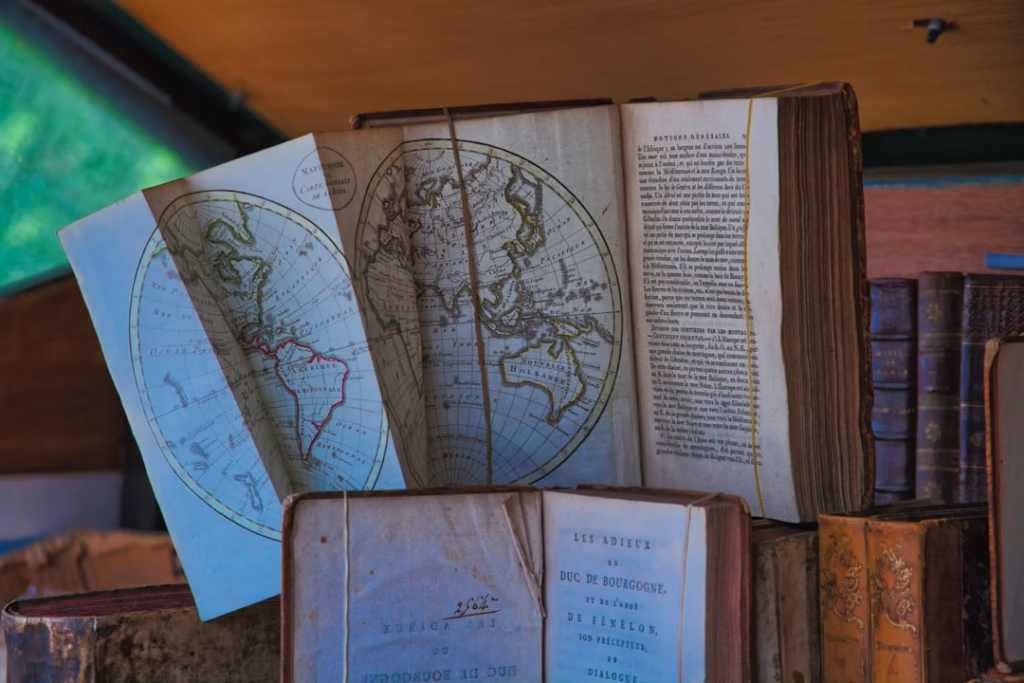
Understanding toponyms helps with navigation of historical maps, cultural identity and language learning. If you enjoy exploring names and their roots, trying out a conversation class in Portuguese can make the stories behind words come alive. I often use italki to practice with native speakers — it’s an easy way to find teachers, try different accents and get feedback on pronunciation. If you want structured practice, search for teachers who focus on history, culture or regional vocabularies.
Quick reference: selected name origins
- Minho — ancient Minius; Indo-European roots (mei- or men-)
- Douro — Celtic dur “water”; Latin Durius
- Trás-os-Montes — “beyond the mountains”
- Beira — “edge,” frontier
- Estremadura — borderland (Reconquista frontier)
- Alentejo — beyond the Tagus
- Algarve — Arabic al-Gharb “the west”
- Porto / Portugal — Portus Cale, Callaeci
- Lisbon — Phoenician/Latin Olissipo “safe harbor”
- Madeira — “wood, timber”
- Azores — named for a raptor believed to be a goshawk (açor)
Final thought
Every place-name is a layer of history about origins of the names of Portugal regions. Rivers and mountains, armies and settlers, saints and trees — all of these left traces in the words we still use today. Exploring the etymology of Portugal’s provinces, districts and islands is an accessible way to connect language, landscape and history.